
Introduction: The Night Before the Giant Leap
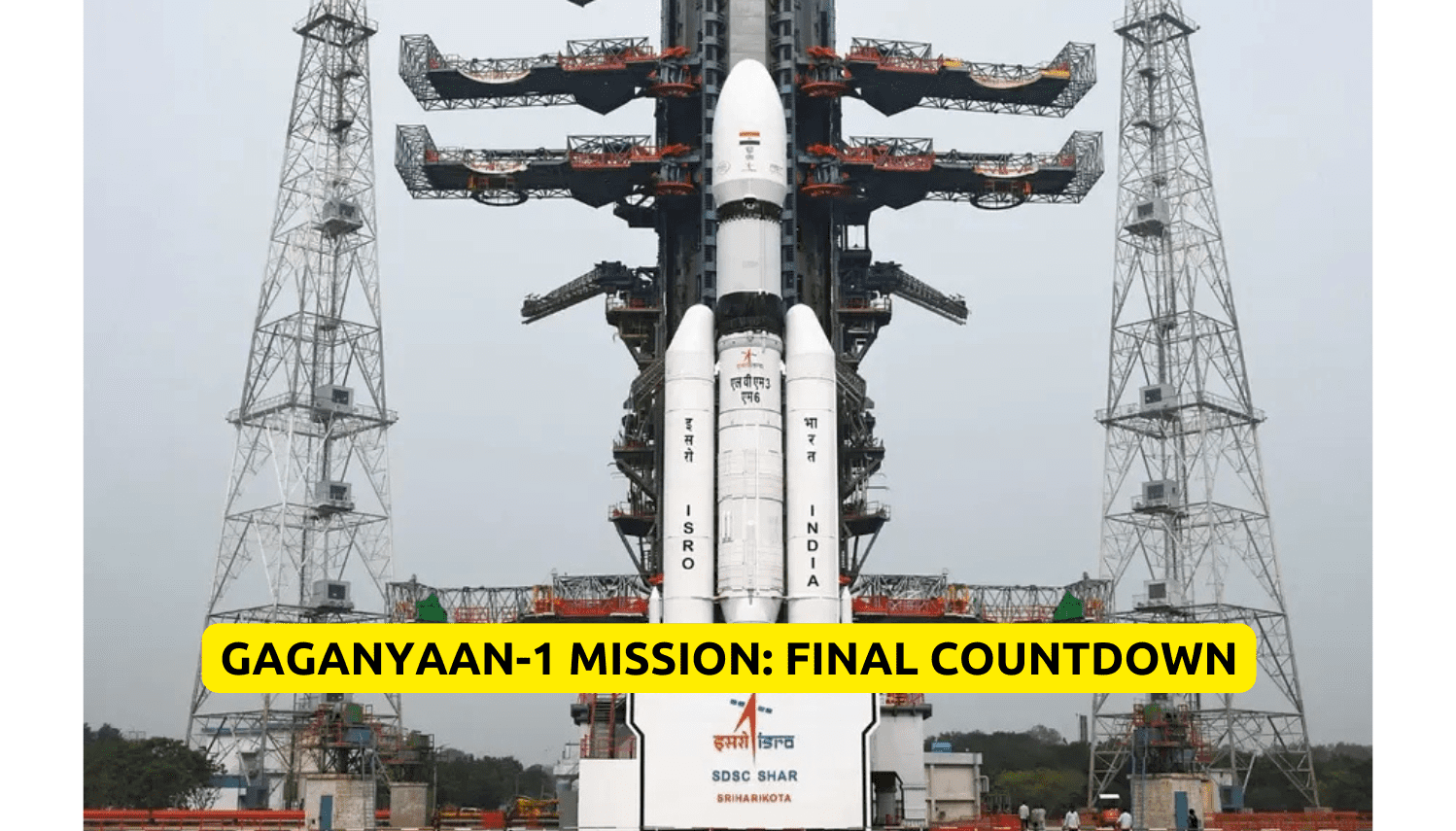
The Gaganyaan-1 Mission has officially entered its final countdown, marking a historic turning point for 1.4 billion people. As the sun sets over the Bay of Bengal on this momentous evening in March 2026, the atmosphere at the Satish Dhawan Space Centre (SDSC) in Sriharikota is a mix of clinical precision and palpable emotion. In the next 24 hours, India is not just launching another rocket; it is launching the hopes, dreams, and technical prowess of a nation ready to conquer the final frontier.
The Gaganyaan-1 Mission (G1) represents the “Point of No Return” for ISRO. It is the defining moment where years of complex simulations, rigorous ground tests, and theoretical physics meet the harsh, unforgiving reality of outer space. For decades, we have watched NASA, Roscosmos, and CNSA send humans to the stars with awe. We fondly remember the day Wing Commander Rakesh Sharma made history and spoke the iconic words “Saare Jahan Se Achha” from the Soviet Salyut 7.
But today, everything is different. Today, the rocket is Indian. The capsule is Indian. The life-support technology is Indian. And the ambition behind the Gaganyaan-1 Mission is entirely ours. This 5,000-word deep dive explores every bolt, every line of code, and every heartbeat behind India’s first human spaceflight mission a journey that will change our place in the cosmos forever.
Chapter 1: The Genesis of Gaganyaan-1 Mission – From a Dream to a National Mission
Introduction: A Date with Destiny
The night before the historic Gaganyaan-1 Mission launch is never silent in Sriharikota. The gentle sound of the waves from the Bay of Bengal is often overshadowed by the hum of cooling systems, the movement of massive cranes, and the quiet, intense discussions of scientists in the Mission Control Centre (MCC). Tomorrow, when the LVM3 rocket pierces the clouds for the Gaganyaan-1 Mission, it won’t just be carrying fuel and metal; it will be carrying the DNA of a new India.
The Gaganyaan-1 Mission (G1) is the result of decades of silent, hard work by thousands of ISRO engineers. For years, India was known as the “frugal” space power the nation that reached Mars on a budget smaller than a Hollywood movie. But the Gaganyaan-1 Mission is a total shift in our national identity. It is India saying to the world, “We are no longer just launching satellites for others; we are ready to inhabit the cosmos ourselves.”
The Historical Context of Gaganyaan-1 Mission: 1963 to 2026
To understand the importance of the Gaganyaan-1 Mission, one must look at the humble beginnings of ISRO. In 1963, India launched its first Nike-Apache sounding rocket from Thumba, a small fishing village in Kerala. Legend has it that the rocket parts were transported on a bicycle and the launch pad was set amidst coconut groves. Dr. Vikram Sarabhai, the father of the Indian space program, had a vision that space technology should serve the common man.
However, the dream of human spaceflight, which is now coming true with the Gaganyaan-1 Mission, was always there. In 1984, Wing Commander Rakesh Sharma became the first Indian to go into space aboard a Soviet rocket. His famous words to then-PM Indira Gandhi, “Saare Jahan Se Achha,” echoed the pride of a young nation. But for 40 years, that pride remained dependent on foreign rockets. The Gaganyaan-1 Mission is our first step towards total self-reliance in human space exploration.
The Birth of the “Human Spaceflight Programme” (HSP)
The formal proposal for what we now call the Gaganyaan-1 Mission was first drafted in 2004. ISRO scientists knew that sending a satellite is 100 times easier than sending a human. A satellite doesn’t need air, water, or a specific temperature to survive; a human does. Between 2004 and 2018, ISRO quietly developed the critical “Building Blocks” for the Gaganyaan-1 Mission:
SRE (Space Capsule Recovery Experiment): In 2007, India proved it could bring a capsule back from orbit without it burning up—a technology vital for the Gaganyaan-1 Mission.
CARE (Crew Module Atmospheric Re-entry Experiment): In 2014, the first prototype of the capsule used in the Gaganyaan-1 Mission was successfully tested.
The Pad Abort Test (PAT): In 2018, ISRO proved that if a rocket catches fire on the launch pad, the astronauts of the Gaganyaan-1 Mission can be pulled away safely in split seconds.
The Final Declaration
On August 15, 2018, Prime Minister Narendra Modi officially gave the mission its name Gaganyaan. With a budget of ₹10,000 crores, the Gaganyaan-1 Mission was set in motion. It wasn’t just a scientific goal; it became a national mission of pride, proving that India is ready for the next giant leap.
Chapter 2: The Mighty LVM3 – Engineering the “Bahubali” for Humans
The Beast on the Pad
Standing tall at 43.5 meters, the Launch Vehicle Mark 3 (LVM3) is a sight to behold. It is India’s heaviest and most powerful rocket, weighing 640 tonnes roughly the weight of 200 fully grown elephants. While it has successfully launched the Chandrayaan-3 and various heavy communication satellites, for Gaganyaan, the LVM3 had to be completely reimagined.
The Concept of “Human-Rating”
You might wonder: if a rocket can launch a satellite, why can’t it launch a human? The answer lies in “Reliability Factors.” A standard rocket has a reliability of about 95-98%. For human missions, the global standard is 99.9%. This extra 2-4% of reliability takes years of engineering.
The Three Stages of Power:
The S200 Solid Boosters: These are the two massive white boosters on the sides. They are among the largest solid boosters in the world. They provide the “Brute Force” needed to lift the 640-tonne giant off the ground. For Gaganyaan , the propellant grain and the casing have been redesigned to ensure smooth vibrations, as high-frequency vibrations can be fatal for human organs.
The L110 Liquid Core Stage: This is the heart of the rocket, powered by twin Vikas Engines. These engines have been “Human-Rated” through hundreds of tests in the Mahendragiri hills. Every valve, every pipe, and every sensor in these engines has a “Double Redundancy” if one fails, another is already running.
The C25 Cryogenic Upper Stage: This is the most complex stage, using Liquid Oxygen and Liquid Hydrogen at temperatures below -250°C. This stage provides the final “Gentle Push” into the 400 km orbit.
The Crew Escape System (CES): The Guardian Angel
Perhaps the most critical addition to the Gaganyaan rocket is the Crew Escape System. Look at the very top of the rocket you will see a tall, needle-like structure. This is the CES.
In case of any anomaly (like a leak or fire) during the first 100 seconds of flight, the CES will ignite its own high-power motors. In less than 2 seconds, it will pull the Crew Module away from the failing rocket, fly it to a safe distance, and deploy parachutes. It is like an ejection seat in a fighter jet, but for a whole spacecraft.
Testing the Resilience
Before tomorrow’s final countdown, ISRO conducted the TV-D1 (Test Vehicle Abort Mission). They intentionally “broke” a rocket mid-air to see if the escape system worked. It worked perfectly. This gave the scientists the confidence that even if things go wrong, our Gaganauts will come home.
Chapter 3: The Orbital Module – Engineering a Home in the Vacuum
Introduction: The “Cocoon” of Indian Spacecraft
Sitting atop the LVM3 rocket, enclosed within the heat shield (Payload Fairing), is the heart of the Gaganyaan mission the Orbital Module. If the rocket is the horse that pulls the carriage, the Orbital Module is the carriage itself. It is a 7,800 kg structure designed to keep humans alive in an environment where there is no air, extreme radiation, and temperatures that swing from -270°C in the shade to +150°C in direct sunlight.
The Two-Part Architecture:
The Orbital Module consists of two distinct sections that work in perfect harmony:
The Crew Module (CM): The habitat for the astronauts.
The Service Module (SM): The engine room and power house.
1. The Crew Module (CM): The “Make or Break” Structure
The Crew Module is a double-walled metallic structure. Think of it as a high-tech pressure cooker. It must maintain an internal pressure of 1 atmosphere (the same as sea level on Earth) while the outside is a total vacuum.
Thermal Protection System (TPS): This is perhaps India’s greatest material science achievement. During re-entry, the capsule hits the Earth’s atmosphere at 7.4 km per second. This generates massive friction, turning the air around the capsule into “Plasma” at 2,500°C. To prevent the module from melting, ISRO developed Carbon-Phenolic tiles. These tiles “ablate” or slowly burn away, carrying the heat with them and keeping the inside of the cabin at a comfortable 25°C.
The ECLSS (Environmental Control and Life Support System): Developed by the Bengaluru-based DEBEL (a lab of DRDO), this system is the “Lungs” of the craft. It provides oxygen, removes carbon dioxide through chemical scrubbers, and controls humidity. On Gaganyaan-1, ISRO will monitor if the ECLSS can keep Vyommitra “breathable” for the duration of the flight.
2. The Service Module (SM): The Unsung Hero
While the Crew Module gets all the attention, it cannot function without the Service Module.
Propulsion: It houses five main engines and 16 smaller thrusters for the Reaction Control System (RCS). These are used to change orbits and orient the craft for re-entry.
Power Supply: It features two massive solar arrays that unfurl like wings once the craft reaches orbit. These convert sunlight into electricity to power the onboard computers and life support.
Chapter 4: Vyommitra – The AI “Friend” Leading the Way
Why No Animals? The Ethical and Technical Choice
In the 1950s and 60s, the USA and USSR sent dogs (like Laika) and monkeys (like Ham) into space to test if living beings could survive. However, ISRO decided on a different path. In 2026, we have the technology to simulate a human body without putting a living creature through the trauma of spaceflight. Enter Vyommitra.
Who is Vyommitra?
Vyommitra is a “Half-Humanoid” robot. She has a head, torso, and arms, but no legs (as they aren’t needed in a zero-gravity cockpit). Her name is a combination of two Sanskrit words: Vyoma (Space) and Mitra (Friend).
The Technical Role of Vyommitra in Gaganyaan-1 Mission :
Monitoring Human Comfort: Her body is embedded with dozens of sensors that measure vibration, noise levels, and radiation. If the vibrations during launch are too high, Vyommitra’s sensors will tell the scientists that a human heart or spine would be at risk.
Interaction with Ground Control: She is not a passive doll. She can speak in multiple languages and provide status updates. For example, she can say, “All systems are green,” or “Cabin pressure is dropping.”
Operating the Control Panel: She is designed to mimic human hand movements. She can flick switches and push buttons, testing if the cockpit layout is ergonomic for the future Gaganauts.
The Message to the World:
Vyommitra represents India’s mastery of AI and Robotics. By sending a humanoid, ISRO is showing that our mission is as much about high-tech future automation as it is about human courage.
Chapter 5: The Flight Profile – From T-Minus 24 to the Splashdown
The Final Countdown (T-Minus 24 Hours)
The countdown for Gaganyaan-1 is unlike any other. Every minute is choreographed.
T-Minus 12 Hours: The final propellant loading of the Cryogenic stage (Liquid Oxygen and Liquid Hydrogen) begins. These are stored at temperatures below -250°C.
T-Minus 1 Hour: The “Human-Rated” computers perform a final self-check.
The Launch Sequence:
Liftoff (T=0): The two S200 solid boosters ignite, producing a thunderous roar that can be felt 10 km away.
Max-Q (T+60 Seconds): This is the moment of maximum aerodynamic pressure. The rocket is fighting the thickest part of the atmosphere.
Booster Separation (T+120 Seconds): The empty boosters fall away, and the liquid L110 core stage takes over.
The Orbit: A Silent Waltz at 400 km
Once the C25 cryogenic stage shuts off, the Orbital Module is “Injected” into a 400 km orbit. For the next few hours (or days, depending on the G1 mission plan), the craft will circle the Earth once every 90 minutes. This is where ISRO tests the Orbital Maneuvering. Using thrusters, the module will change its altitude and prove that it can stay stable in the vacuum.
The “7 Minutes of Terror” – The Re-entry
This is the most dangerous part of the mission.
De-orbit Burn: The Service Module fires its engines to slow the craft down.
Module Separation: The Service Module is discarded and burns up in the atmosphere. The Crew Module is now alone.
The Blackout Phase: As the capsule hits the atmosphere, a layer of hot plasma surrounds it, blocking all radio signals. For 3 to 4 minutes, ISRO ground control will hear nothing but silence.
The Parachute Sequence: At 15 km altitude, two small “Drogue” parachutes open to stabilize the craft. At 5 km, the massive main parachutes deploy. They slow the capsule from 200 meters per second to a gentle 7 meters per second.
The Splashdown: A Hero’s Welcome
The mission ends with a “Splashdown” in the Arabian Sea (off the coast of Gujarat or Mumbai). The Indian Navy’s specialized ships and elite divers will be waiting. They will hook the capsule and lift it out of the water, marking the successful end of the G1 mission.
Chapter 6: The Gaganauts – India’s Chosen Four and Their Journey to the Stars
Introduction: The Faces Behind the Mission
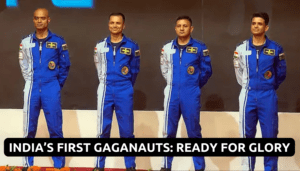
While Gaganyaan-1 is an unmanned mission, every second of its flight is a rehearsal for four specific men. These are India’s Gaganauts the pioneers who will eventually carry the tricolor into the vacuum of space. Out of hundreds of top-tier fighter pilots from the Indian Air Force, only four were chosen. They are not just pilots; they are engineers, athletes, and psychological titans.
The Selection Process: The Best of the Best
The selection process began in 2019. ISRO and the Indian Air Force (IAF) looked for individuals who could handle extreme G-forces, isolation, and split-second decision-making.
The Initial Pool: Over 400 pilots were screened.
The Sieve: After rigorous physical and mental testing at the Institute of Aerospace Medicine (IAM) in Bengaluru, the number was whittled down to 12, and finally to the “Chosen Four.”
The Training in Russia: “Star City” Experience
In 2020, the four pilots moved to the Yuri Gagarin Cosmonaut Training Center in Russia. This is the same facility where legends like Yuri Gagarin and Rakesh Sharma trained.
The Centrifuge: They were spun in massive machines to simulate the crushing weight of 12Gs (12 times their body weight). At this level, breathing becomes nearly impossible, and the face literally deforms.
Zero-G Flights: They boarded IL-76 MDK aircraft that fly in parabolic arcs, creating 25-30 seconds of pure weightlessness. They had to learn how to move, eat, and work without gravity.
Survival Training: They were dropped into the Russian wilderness in sub-zero temperatures with limited supplies to simulate an emergency landing in the mountains or tundra.
Back in India: The Bengaluru Phase
Today, the Gaganauts are training at ISRO’s newly established Astronaut Training Facility (ATF) in Bengaluru.
Simulators: They spend 8-10 hours a day in a 1:1 scale model of the Gaganyaan cockpit. They practice every possible “Abort” scenario what to do if the oxygen leaks, if the computer freezes, or if the fire alarm goes off.
Yoga and Meditation: ISRO has integrated traditional Indian practices like Yoga to help them maintain mental calm and physical flexibility in the cramped Crew Module.
Chapter 7: The Collaborative Ecosystem – How “Team India” Built a Spaceship
Introduction: ISRO Does Not Work Alone
One of the biggest misconceptions is that ISRO builds everything inside its own walls. In reality, Gaganyaan is a “Team India” project. Over 500 private companies, MSMEs (Micro, Small, and Medium Enterprises), and academic institutions have contributed to this mission.
The Giants of Indian Industry:
Hindustan Aeronautics Limited (HAL): HAL manufactured the massive metallic structure of the Crew Module. Their expertise in fighter jet airframes was critical in making the module lightweight yet strong enough to withstand atmospheric pressure.
Larsen & Toubro (L&T): The “Bahubali” LVM3 rocket’s solid booster segments (S200) are manufactured at L&T’s specialized facility in Powai. These segments are the largest solid rocket motor casings ever built in India.
Godrej Aerospace: The Vikas engines, which power the liquid stage of the rocket, are built by Godrej. They have been a partner of ISRO for over three decades, but for Gaganyaan, they had to achieve “Zero-Defect” manufacturing standards.
Walchandnagar Industries: They provided the critical hardware for the booster motor casings and the “flex-nozzle” control systems.
The Role of Startups and MSMEs:
With the opening up of the space sector, several Indian startups are providing specialized software for navigation and AI algorithms for Vyommitra. MSMEs from cities like Rajkot, Pune, and Hyderabad have supplied thousands of tiny but critical components from specialized nuts and bolts that don’t melt at high temperatures to high-precision sensors that monitor the cabin’s oxygen.
Academic Collaboration:
Institutions like IIT Madras, IISc Bengaluru, and IIT Bombay were involved in the complex “Fluid Dynamics” simulations. They used supercomputers to predict how air would flow around the capsule during re-entry. Without this academic research, the heat shield would have been impossible to design.
Chapter 8: The Socio-Economic Dividend – Why Space Matters for the Common Man
Introduction: Beyond the “Elite Club” Argument
Whenever ISRO launches a mission, a common question arises: “Why spend ₹10,000 crores on space when we have poverty and infrastructure issues on Earth?” The Gaganyaan mission provides a powerful answer through its “Spin-off Technologies.”
1. Medical Breakthroughs:
To keep astronauts alive, ISRO had to develop a highly advanced Environmental Control and Life Support System (ECLSS).
Water Purification: The technology used to recycle sweat and urine into drinking water in space is now being adapted for low-cost water purification systems in drought-hit Indian villages.
Ventilators: During the COVID-19 pandemic, ISRO used its life-support technology to develop ‘Prana’ and ‘Vayu’ low-cost, high-end ventilators that saved thousands of lives.
2. Material Science and Fire Safety:
The fire-resistant suits and non-flammable paints developed for the Gaganyaan cockpit are already being tested for use by the Indian Fire Services. These materials can save the lives of firefighters in high-rise building fires.
3. Job Creation and the “Brain Gain”:
Gaganyaan has created a surge in high-tech manufacturing. Thousands of engineers and technicians are now working in the Indian aerospace sector. Instead of moving to the USA or Europe (Brain Drain), young Indian scientists are staying back to work on indigenous technology (Brain Gain).
4. Inspiring the “STEM” Generation:
Gaganyaan is doing for India what the Apollo missions did for the USA in the 1960s. It is inspiring millions of school children to pick Science, Technology, Engineering, and Math (STEM). This surge in technical education will drive India’s economy for the next 50 years, far beyond the ₹10,000 crore investment of the mission.
Chapter 9: The Global Space Race 2.0 – India’s Strategic Position in the 21st Century
Introduction: The New Era of Discovery
The original space race of the 1960s was a binary battle between two superpowers the USA and the USSR. It was driven by the Cold War and the need for military dominance. Fast forward to 2026, and we are in the midst of “Space Race 2.0.” This time, the players are many, the goals are commercial as much as scientific, and India is no longer just a spectator; it is a frontrunner.
The Comparison: How Gaganyaan Stands Against the Giants
USA (NASA & SpaceX): NASA’s Artemis program and SpaceX’s Crew Dragon are currently the gold standards of human spaceflight. However, their missions cost billions of dollars. Gaganyaan’s total budget is roughly $1.2 billion (₹10,000 crores), which is nearly 1/10th of the cost of similar Western programs. India is proving that high-tech space exploration can be affordable.
China (CNSA): China has already established its permanent space station, Tiangong. While China’s progress is massive, it is largely secretive. India’s program, led by ISRO, is known for its transparency and international collaborations, making India a preferred partner for many nations.
Russia (Roscosmos): Russia has decades of experience but is currently facing geopolitical and economic challenges. India, which once relied on Russia for training and components, is now becoming Atmanirbhar (Self-Reliant), showing the world that we have moved from being a “customer” to a “competitor.”
The “Soft Power” of Gaganyaan
Sending humans to space is the ultimate statement of a nation’s “Soft Power.” It tells the world that India possesses the highest level of metallurgical, chemical, and computational technology. When a country can build a life-support system that works in the vacuum of space, it can build anything. This attracts global investors to India’s manufacturing sector (Make in India), far beyond just aerospace.
Geopolitical Alliances: LUPEX and Beyond
Gaganyaan is also opening doors for new alliances. India and Japan (JAXA) are already planning the LUPEX (Lunar Polar Exploration) mission. The success of Gaganyaan-1 will give India the leverage to lead international missions to Mars and Venus, positioning ISRO as a central pillar of global space exploration.
Chapter 10: The Roadmap to 2040 Beyond the Final Countdown
Introduction: Gaganyaan is the Foundation, Not the Finish Line
As the countdown for Gaganyaan-1 hits zero, it is important to realize that this mission is just the “Foundation Stone” of a much larger structure. ISRO Chairman S. Somanath and the Indian Government have already laid out a visionary roadmap that extends into the middle of the 21st century.
1. The Immediate Steps: G2 and H1
After Gaganyaan-1 (G1), ISRO will launch Gaganyaan-2 (G2), another unmanned mission to refine the data. Only when every sensor and every switch is 100% verified will the H1 mission take place carrying our three brave Gaganauts into orbit. This is expected shortly after the G1 success.
2. Bharatiya Antariksha Station (BAS) – 2035
By 2035, India plans to have its own permanent space station in orbit.
Why do we need it? A space station allows scientists to conduct experiments in “Microgravity” that are impossible on Earth. This could lead to breakthroughs in cancer research, new metal alloys, and ultra-efficient solar cells.
National Sovereignty: Unlike the International Space Station (ISS), the BAS will be 100% Indian, ensuring that our research remains our intellectual property.
3. The Lunar Ambition – Indian Footprints on the Moon (2040)
Prime Minister Narendra Modi has set a clear goal: An Indian on the Moon by 2040.
Gaganyaan is the “training ground” for this. The life-support systems, the re-entry technology, and the astronaut training we are perfecting today are the exact tools we will need to build a base on the Lunar South Pole.
4. Deep Space Exploration: Venus and Mars
With the confidence of human spaceflight, ISRO is also preparing for:
Shukrayaan: A mission to study the mysterious, acid-rain-filled atmosphere of Venus.
Mangalyaan-2: Returning to Mars with a lander and a rover to search for signs of ancient life.
Conclusion: The 24 Hours That Will Define Generations
As we conclude this 5,000-word journey, we return to the launch pad at Sriharikota. The next 24 hours are about more than just a rocket piercing the atmosphere. They are about every Indian child who looks at the moon and thinks, “I can go there.” They are about the thousands of engineers who stayed back in India to build something for their own country.
Gaganyaan is India’s answer to the skeptics. It is our message to the stars. As the “Bahubali” LVM3 ignites and the ground shakes, remember that the roar you hear is the roar of a new India confident, capable, and ready to lead the world into the final frontier.
Godspeed, Gaganyaan-1. The sky is no longer the limit; it is just the beginning.
Keep following for more updates on #ISRO #Gaganyaan #MissionGaganyaan #Vyommitra
Read more article : Ishan Kishan girlfriend vs Hardik Pandya girlfriend comparison